Mechanical Turk is no longer available.
Amazon Mechanical Turk permanently closed on September 30, 2026. Please visit our FAQ page for more information.

Amazon Mechanical Turk is permanently closed as of September 30, 2026. Please find FAQs below addressing common questions about the closure.
What should I do to ensure I'm paid following MTurk's closure?
You have until October 30, 2026 to verify your payment
preferences within the MTurk Worker Portal. Validate that
you have a payment method and a payment frequency setup.
If you have not set up a transfer schedule, go to the
Account Settings page > Manage Payment Preferences and
select a transfer schedule for your earnings. After
October 30, 2026, please contact
Customer Service
for further payment update requests.
How will I get paid after MTurk's closure?
Payments will be distributed based on your existing
payment schedule. If you haven't received your funds within
that time, please contact MTurk
Customer Service.
Will I still receive my latest tax documents from MTurk?
Yes, MTurk will still distribute any tax-related
documentation via our
established processes and deadlines.
Will I get paid for all HITs completed before closure?
Yes, all remaining completed and approved HITs will be paid
out during your normal scheduled disbursement.
Will I be able to receive bonuses for completed HITs?
Requesters can award bonuses until October 30, 2026.
What happened to HITs that were pending approval on or after September 30, 2026?
Requesters have 30 days, until October 30, 2026 (per our
standard
HIT approval policy),
to approve or reject any completed HITs. If no action is
taken, they will be auto-approved.
Is there anything I, as a Requester, need to do following the closure?
Yes, please verify your payment information within the
MTurk Requester Portal by October 30, 2026. This will
ensure that any refunds are processed in a timely manner.
After October 30, 2026, please contact
Customer Service
for further payment update requests.
When will my pre-paid Requester balance be refunded?
You should expect a full balance refund within 30 days of
the September 30, 2026 closure. If you haven't received
your refund within that timeframe, please contact MTurk
Customer Service.
When will I receive my final bill from AWS Billing?
Customers will receive a final bill from MTurk in the
respective upcoming billing cycles following the
September 30, 2026 closure.
Will I be charged for any incomplete HITs after the closure?
No. HIT submission closed on September 30, 2026. Requesters
have 30 days (until October 30, 2026) from the closure to
approve submitted HITs. All remaining unsubmitted HITs have
automatically expired.
Can I provide a bonus to workers for completed HITs?
Yes. Requesters can award bonuses until October 30, 2026.
What happened to HITs that were pending approval on or after September 30, 2026?
Requesters have 30 days, until October 30, 2026 (per our
standard
HIT approval policy),
to approve or reject any completed HITs. If no action is
taken, they will be auto-approved.
What other AWS services does MTurk's closure affect?
This closure also applies to SageMaker Ground Truth and
Amazon Augmented AI. The Amazon Mechanical Turk Worker type
is no longer available for creating labeling jobs or human
review workflows as of September 30, 2026.
How long will I be able to access my transaction history?
Your transaction history will remain available until
January 28, 2027.
In 1769, Hungarian nobleman Wolfgang von Kempelen astonished Europe by building a mechanical chess-playing automaton that defeated nearly every opponent it faced. A life-sized wooden mannequin, adorned with a fur-trimmed robe and a turban, Kempelen's “Turk” was seated behind a cabinet and toured Europe, confounding such brilliant challengers as Benjamin Franklin and Napoleon Bonaparte. To persuade skeptical audiences, Kempelen would slide open the cabinet's doors to reveal the intricate set of gears, cogs and springs that powered his invention. He convinced them that he had built a machine that made decisions using artificial intelligence. What they did not know was the secret behind the Mechanical Turk: a chess master cleverly concealed inside.
Today, we build complex software applications based on the things computers do well, such as storing and retrieving large amounts of information or rapidly performing calculations. However, humans still significantly outperform the most powerful computers at completing such simple tasks as identifying objects in photographs – something children can do even before they learn to speak.
When we think of interfaces between human beings and computers, we usually assume that the human being is the one requesting that a task be completed, and the computer is completing the task and providing the results. What if this process was reversed and a computer program could ask a human being to perform a task and return the results? What if it could coordinate many human beings to perform a task?
Amazon Mechanical Turk (MTurk) provides a service for service requesters (hereafter “Requesters”) to integrate Artificial Artificial Intelligence directly into their applications by making requests of humans. Requesters can use the MTurk web user interface or web services API to submit tasks to the MTurk web site, approve completed tasks, and incorporate the answers into their applications. When using the web services API, the transaction looks very much like any remote procedure call – the application sends the request, and the service returns the results. In reality, a network of human Workers (hereafter “Workers”) fuels this Artificial Artificial Intelligence by coming to the web site, searching for and completing tasks, and receiving reward for their work.
All Requesters need to do is write normal code. The pseudo code below illustrates how simple this can be.
  read(photo);
  photoContainsHuman = callMechanicalTurk(photo);

  if (photoContainsHuman == TRUE) {
      acceptPhoto();
  } else {
      rejectPhoto();
  }
When the Requester approves a submitted HIT, Amazon Mechanical Turk automatically displays Worker earnings on their Dashboard and Earnings pages. Earnings are transferred to their virtual US bank account or to their Amazon.com gift card balance on a regular schedule.
Businesses can create and publish HITs on Amazon Mechanical Turk using the Requester web user interface (UI), the API, or the command line interface (CLI). Visit the Requester User Interface Guide to learn more about the UI or the developer getting started guide to learn about the API or CLI.
We currently accept registrations from the following countries:
Barbados, Chile, Canada, French Guiana, Guadeloupe, Martinique, Puerto Rico, United States, US Minor Islands, US Virgin Islands
Botswana, Mayotte, Réunion, South Africa
Australia, French Polynesia, French Southern Territories, Hong Kong, Israel, Japan, New Caledonia, New Zealand, Qatar, Singapore, South Korea, Taiwan
Austria, Belgium, Denmark, Estonia, Finland, France, Germany, Iceland, Ireland, Italy, Lithuania, Luxembourg, Malta, Netherlands, Norway, Poland, Portugal, Romania, Slovenia, Spain, Sweden, Switzerland, United Kingdom
You can view and edit your account information by accessing your My Account page. Please note that your MTurk Requester account is associated with your Amazon.com account so when you edit your personal settings, they will be changed on the corresponding Amazon.com account.
You can view and edit your contact address on Amazon.com.
You can review Amazon Mechanical Turk pricing here.
After the fee is calculated, we round half up amounts greater than $0.01 – we round down if the fractional amount is less than half a penny, and round up otherwise. For example, $0.104 is rounded to $0.10, $0.105 is rounded to $0.11, and $0.108 is rounded to $0.11.
Workers will be paid and Amazon Mechanical Turk (MTurk) fees will be charged when you approve submitted work. If you reject the work, the Worker is not paid and you are not charged the MTurk fees. MTurk HITs are subject to Participation Agreement. You can review MTurk pricing here.
With AWS billing, invoicing is sent via email on a monthly basis and also available for download from the Billing Console on demand. If you need to configure invoicing without a credit card or if you need additional support visit mturk.com/contact-us.
If you need a more detailed receipt, you can contact mturk.com/contact-us to have a copy of your receipt emailed to you. In order to process your request, please provide the transaction time period to be included in the receipt.
You can download your transaction history for your records here.
Amazon Mechanical Turk (MTurk) has built technology which analyzes Worker performance, identifies high performing Workers, and monitors their performance over time. Workers who have demonstrated excellence across a wide range of HITs are awarded the Masters Qualification. Masters must continue to pass our statistical monitoring to maintain the MTurk Masters Qualification.
Yes, all non-U.S. based Workers are required to provide their tax information through a tax information interview before doing any work on Mechanical Turk just as U.S. Workers are required to do. The tax information interview collects the U.S. tax status (for U.S. person or non-U.S. person), the name, and the permanent residence address of the individual that will report the income on an income tax return.
Similar to today you approve, reject, and bonus submitted HITs by Workers on the Requester website. Any unapproved submitted HITs will be automatically approved after 30 days.
No, this change will not affect your payments. You will continue to receive your payments once your work gets approved.
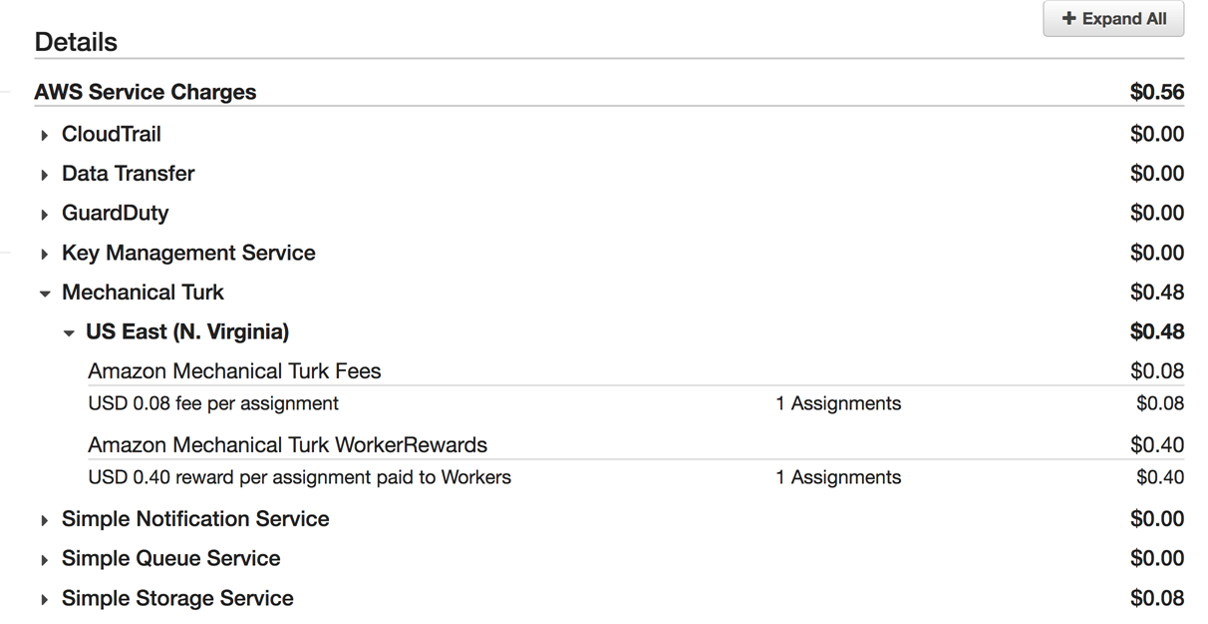
All approved assignments will appear on your AWS bill under two categories: Mechanical Turk Fees and Mechanical Turk Worker Rewards.
The Amazon Mechanical Turk (MTurk) Requester website allows Requesters to access the MTurk Worker community. The Requester UI Guide explains how to design, publish, and manage your HITs on the Requester website.
Check out our blog post to learn more about getting started with Surveys and the importance of selecting Qualifications. You can also create Custom Qualifications to include or exclude Workers across multiple survey batches or for longitudinal research. You may also want to consider deploying linked surveys.
When you reject an assignment, the Worker who performed the assignment is not paid, and you are not charged the standard Amazon Mechanical Turk fee for the HIT. The rejection may affect your reputation as a Requester and the approval rate of the Worker who submitted the results. Please note that you may not reject an assignment without good cause and rejections can be reversed if you determine that a mistake was made.
MTurk will remove HITs and corresponding Assignment data from your account after 120 days. If you require access to HIT and Assignment data for longer than 120 days, we recommend you download the HIT results and store them locally.
You may not use Amazon Mechanical Turk for illegal or objectionable activities. Please refer to the policy page for examples. For example, Requesters are not allowed to collect personally identifiable information from Workers.
This can be achieved by using qualifications. Requesters can create a Qualification Type or use an existing Qualification Type to assign it to the Workers who have completed the HIT (e.g. survey) once. When creating the next HIT, Requesters can specify that only Workers who have not been granted the Qualification Type can work on the HIT. This can be done through the UI and the API.
Requesters can specify criteria at the time of creating the project. The available attributes can be specified in the “Worker Requirements” section of the Requester Website.
Yes, using the Create Project feature on the Requester Website, Requester customers can use Premium Qualifications for any kind of HIT that has 10 or more Assignments, including Surveys. The Sentiment and Categorization Project types do not support Qualifications, nor does the Create HITs Individually feature.
The use of each of the Premium Qualifications incurs an additional fee per approved assignment based on the specific Premium Qualification chosen. For more detail, see our Pricing page.
Custom Qualifications can be designed by Requesters to select or exclude specific worker attributes. You can also create Custom Qualifications to include or exclude Workers across multiple survey batches or for longitudinal research. For more information, see our documentation on Managing Qualification Types. Note: Custom Qualifications can be used across Requester accounts so it is possible to share your Custom Qualifications should you choose to do so.
The maximum number of HITs in a batch is 250,000 (or 500 in our Sandbox environment).
In order to publish more than the maximum number of HITs at a time, you may break your input file into multiple smaller files containing less than or equal to the maximum number of HITs. If your use case requires you to publish more than the maximum number of HITs in a single batch, please contact us.
Amazon Mechanical Turk (MTurk) provides Requester facing APIs as well as developer tool kits (SDKs). To get started, visit our developer Getting Started Guide.
In order to call the MTurk APIs, Requesters must have registered for AWS accounts and retrieved their IAM credentials. This is because MTurk uses the AWS account to identify and allow access for developers using the MTurk APIs. We’re not using AWS to track MTurk API usage, but your Mturk Fees and Worker Rewards will appear on your AWS Bill.
No. As a public crowd marketplace, MTurk is not designed for sharing or publishing HITs containing personal or sensitive data. It is your responsibility as a Requester to determine whether your HIT content contains any personal or sensitive data. For more information see our Acceptable Use Policy.
Yes, so long as your survey does not derive any personally identifiable information from Workers. For example, you may ask Workers for their occupation, relationship status, etc., but you may not ask Workers for personally identifiable information, such as their full name, email address, phone number, or equivalent in any HIT including survey HITs. Surveys should only be posted for legitimate academic or market research purposes.
Unique Worker IDs are made available by MTurk to facilitate your use of the MTurk service only and for no other purpose. For example, you may use Worker IDs to distinguish between Workers who complete your HITs, and manage Workers such as tracking how many HITs a particular Worker has completed. You may not use Worker IDs to try to derive the real identity of any Worker, or otherwise publicly post or share them.